On this page
The Short Answer
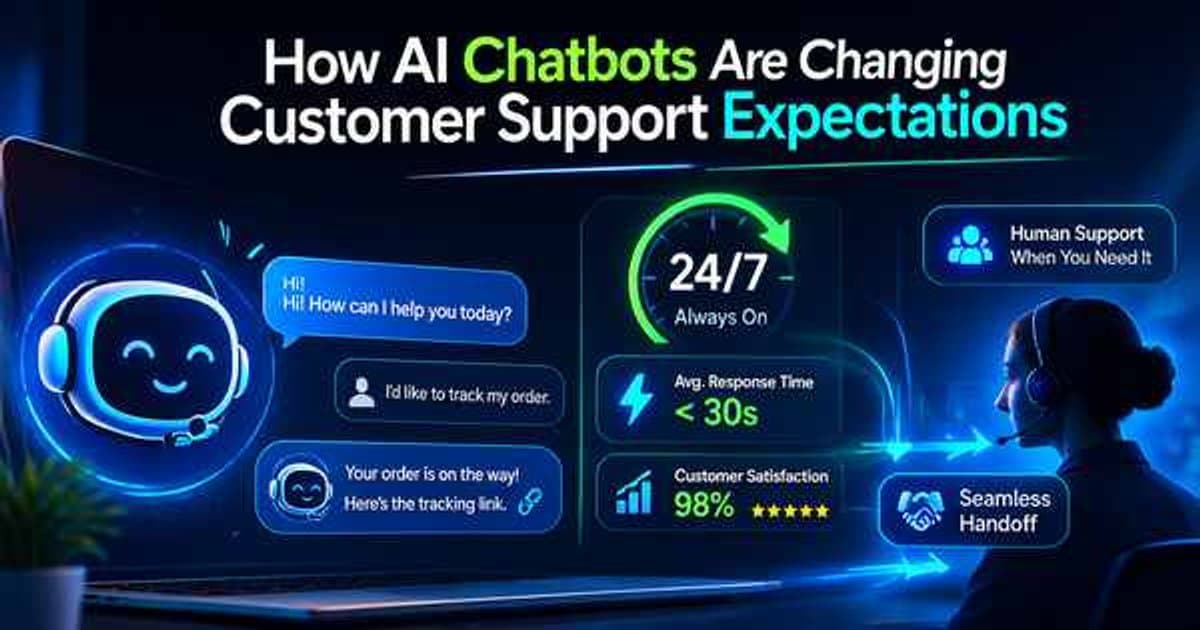
Customers now expect an instant response at any hour, not a same-day reply. AI chatbots meet that bar by answering common questions immediately and acknowledging complex ones, then passing them to a person with full context. Customers care about fast, accurate answers rather than who gives them; what damages trust is a bot loop with no route to a human.
Instant Response Has Become the Baseline, Not the Bonus
A few years ago, a same-day response felt reasonable. Now, an instant acknowledgment is the expectation, shaped by every other app and service a customer interacts with daily. Support teams that still rely purely on email or business-hours-only channels are increasingly measured against a standard they were never built for.
This isn't really about impatience — it's that people have learned instant response is possible, and once it's possible somewhere, it becomes the expectation everywhere.
Source: HubSpot — Live Chat Exposes a Fatal Flaw in Your Go-to-Market (March 2025).
Where AI Actually Fits Into That Expectation
AI-powered support doesn't need to answer every question perfectly to be valuable — it needs to close the gap between "a customer has a question" and "a customer gets useful movement on that question," instantly, any time of day.
For common, well-defined questions, that means a direct, accurate answer immediately. For anything more complex, it means an instant acknowledgment and a clear next step, with full context handed to a human rather than the customer starting over.
What Customers Actually Notice — and What They Don't
Many customers are wary of AI in support: in a 2024 Gartner survey, 64% said they would prefer companies didn't use it, and their top worry was losing access to a person. What earns trust is an accurate, quick answer and an easy route to a human. The businesses getting this right treat AI support as infrastructure, not a gimmick, quietly handling volume in the background.
What customers do notice is when a bot clearly can't help and traps them in a loop with no way to reach a real person — that's the failure mode that damages trust, not the presence of AI itself.
Source: Gartner — Gartner Survey Finds 64% of Customers Would Prefer That Companies Didn't Use AI For Customer Service (July 2024).
Building Support That Scales Without Losing the Human Touch
The goal isn't to remove people from support — it's to make sure the people involved are working on the conversations that actually need them. That balance is what separates support that scales well from support that just gets automated poorly.
Done well, this looks like faster answers for routine questions and more attentive, unhurried service for complex ones — a better experience at both ends, not a worse one at either.
This is part of our Customer Support service — see how it works, what's included, and what it typically costs.
Running a business in this sector? See how this applies in our guide to AI automation for SaaS.