On this page
The Short Answer
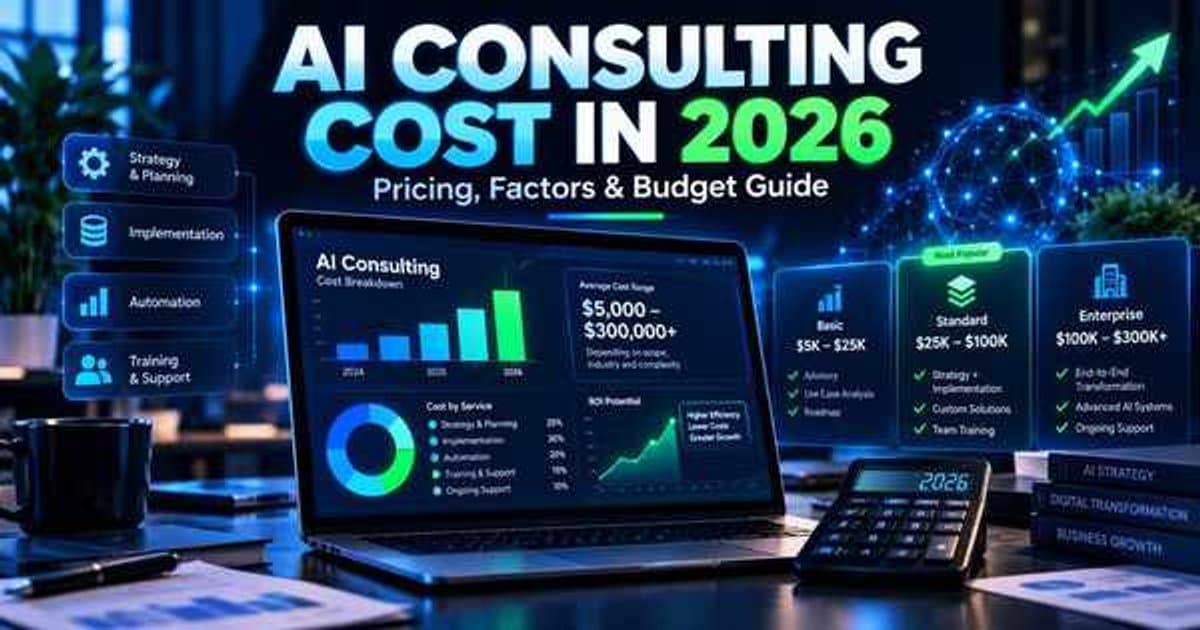
Based on publicly available 2026 AI-consulting rate guides, independent consultants focused on small-business work typically charge $100-$300 per hour — toward the conservative end of the broader market, where larger firms and specialized generative-AI work commonly run $300-$500+ per hour. A defined small-business project — automating one workflow or building a single AI agent — typically runs $2,000-$15,000, while a full AI strategy assessment runs $5,000-$25,000. Ongoing advisory retainers for smaller businesses commonly start in the low thousands of dollars a month.
What AI Consultants Charge by the Hour
Hourly rates vary more in AI consulting than almost any other factor, mostly driven by experience and specialization. Junior consultants typically charge $100-$150 an hour, while senior specialists charge $300-$500+. Independent consultants working with small businesses tend to land in the $100-$300 range — below what some broader market guides report for the industry overall, since those figures often blend in larger firms and specialized generative-AI work, which commonly run $300-$500+ regardless of the specific engagement and can add a further 20-30% premium on top of standard rates for deep, current generative-AI expertise.
- Junior consultant: $100-$150/hour
- Independent consultant (small business focus): $100-$300/hour
- Senior specialist: $300-$500+/hour
- Large consulting firm: $300-$500+/hour
Sources for these ranges (public rate guides, checked October 2026):
- Orient Software, “AI Consulting Rate: A Breakdown of Hourly, Project, and Retainer Models” (updated August 2026): junior consultants about $100-$150/hour; senior experts and niche specialists up to $300-$500+.
- Layer3 Labs, “AI Consulting Rates and Pricing in 2026” (updated September 2026): freelance AI consultants $75-$150/hour, boutique AI agencies $125-$250/hour, enterprise firms $250-$500/hour.
- Softude, “AI Consulting Cost in 2026: Pricing, Engagement Models, and What to Expect” (July 2026): independent experts and freelancers $150-$300/hour, mid-market IT consulting firms $250-$500/hour.
Project-Based Pricing: What a Defined Engagement Costs
Most small businesses don't actually want an hourly arrangement — they want a defined project with a clear scope and a clear price. For a small business automating one workflow or building a single AI agent, publicly available 2026 pricing guides put that in the $2,000-$15,000 range. A proper AI strategy assessment — mapping where AI fits across a business before building anything — typically runs $5,000-$25,000. Analyses covering several departments, and enterprise-wide AI programs, are typically priced well into five or six figures, depending on scope.
The gap between these numbers is almost entirely about scope, not quality — a one-workflow automation and a company-wide AI transformation are fundamentally different projects, not the same project priced differently.
Ongoing Retainers: What Continued Support Costs
A one-time project gets something built; a retainer keeps it working and improving. For smaller businesses, ongoing retainers covering monitoring, optimization, and continued support commonly start in the low thousands of dollars a month. Upwork's hiring guide lists ongoing AI consulting retainers at $2,000-$10,000. Larger ongoing advisory retainers — closer to a fractional AI strategy role than hands-on support — run roughly $4,000-$8,000 a month. Many engagements start as a one-time project and only move to a retainer once the build is live and the business can see what ongoing support would actually involve.
Day Rate vs. Hourly vs. Project vs. Retainer
AI consultants price work in four main ways. Each one puts the cost risk in a different place.
| Pricing model | How it's billed | Who carries the risk | Best fit |
|---|---|---|---|
| Hourly | Time actually spent | You: more hours means a bigger bill | Small or loosely defined requests |
| Day rate | A fixed price per working day | You, but in larger units that are easier to plan | Workshops, discovery days and on-site work |
| Fixed project | One price for an agreed scope | The consultant, as long as the scope holds | A defined build, such as one workflow or one agent |
| Retainer | A monthly fee for an agreed level of support | Shared: you pay for availability, used or not | Monitoring and improvements after launch |
Day rates are common in the UK, in Europe and in public-sector buying. For example, one AI supplier's rate card on the UK government's G-Cloud 15 framework lists £450 a day at its most junior skill level and £1,500 a day at its most senior. Its working day is 7.5 hours (G-Cloud 15 supplier rate card). That is one supplier's card, not a market average.
Freelance marketplaces publish project figures too. Upwork's hiring guide lists approximate prices of $500-$2,500 for an AI strategy assessment, $5,000-$25,000+ for an implementation project and $2,000-$10,000 for an ongoing consulting retainer (Upwork, hiring AI consultants). Marketplace freelancers often price below consulting firms, which is why some of these figures sit under the ranges above. Upwork also suggests fixed-price contracts for work with clear deliverables, and hourly contracts for ongoing or open-ended work.
Illustrative Example: Budgeting a First AI Project
Illustrative example: hypothetical figures to show the arithmetic, not a quote. A 12-person services business wants to automate lead intake. Today, a staff member copies web-form enquiries into the CRM and writes each first reply by hand.
| Phase | Effort | At $150/hour | What it covers |
|---|---|---|---|
| Discovery and process mapping | 8 hours | $1,200 | Map the current steps and agree the scope |
| Build and integration | 30 hours | $4,500 | Form to AI qualification to CRM to draft reply |
| Testing with the team | 8 hours | $1,200 | Real enquiries, edge cases and fixes |
| Launch support (first month) | 6 hours | $900 | Monitoring and small adjustments |
| Total | 52 hours | $7,800 | Before software and AI usage fees |
The $150 rate sits inside the independent-consultant range above. Priced as a fixed project, a quote would usually land near this total plus a buffer for unknowns. After launch, a smaller monthly retainer could cover monitoring and changes.
Notice what moves the total. A different hourly rate changes it in proportion. A bigger scope changes it more: a second workflow adds its own build and testing phases.
Costs Outside the Consultant's Fee
The consultant's invoice is rarely the whole budget. Plan for these costs as well:
- Automation platform fees. Workflow tools charge by usage. For example, n8n lists its cloud Starter plan at €20 a month, billed annually, for 2,500 workflow executions (n8n pricing).
- AI usage fees. AI models and support agents are usually metered. Intercom, for instance, prices its Fin AI agent at $0.99 per outcome (Intercom pricing).
- Your team's time. Discovery interviews, testing and sign-off all need hours from the people who run the process today.
- Ongoing changes. Connected apps update their APIs, and your own process changes too. Budget for small fixes, through a retainer or occasional hours.
Ask any consultant to list these running costs in the proposal. A clear estimate of what the system costs each month is as useful as the build price.
What Actually Moves the Price
Four factors do most of the work in determining what an engagement actually costs:
- Experience level: a junior consultant and a specialist with a strong track record are not interchangeable, and the rate reflects that.
- Project scope: one workflow versus a company-wide rollout is the single biggest driver of total cost.
- Geographic location: rates vary meaningfully between regions and between independent consultants and larger firms.
- Pricing model: hourly, fixed-project, and retainer arrangements shift risk differently between the business and the consultant, which shows up in the final number.
Pricing for a specific project is always more useful than a general number — which is exactly why we scope every engagement individually rather than publishing a flat rate that would be wrong for most businesses either way.
Source: UK Government Digital Marketplace (G-Cloud 15 supplier pricing document) — NixInfinity-AI Rate Card 2026 (January 2026).
Quick Comparison at a Glance
Rates last checked: October 2026. Ranges reflect small-business and independent-consultant engagements specifically — broader industry guides covering enterprise and specialized generative-AI work report higher figures.
| Pricing model | Typical range | Best fit |
|---|---|---|
| Hourly (independent) | $100-$300/hr | Small, flexible-scope work |
| Hourly (senior/firm) | $300-$500+/hr | Specialized or high-stakes work |
| Defined project (small business) | $2,000-$15,000 | One workflow or a single AI agent |
| Strategy assessment | $5,000-$25,000 | Mapping where AI fits before building |
| Monthly retainer (smaller business) | From about $2,000/mo | Ongoing support after launch |
This is part of our AI Consulting service — see how it works, what's included, and what it typically costs.