On this page
The Short Answer
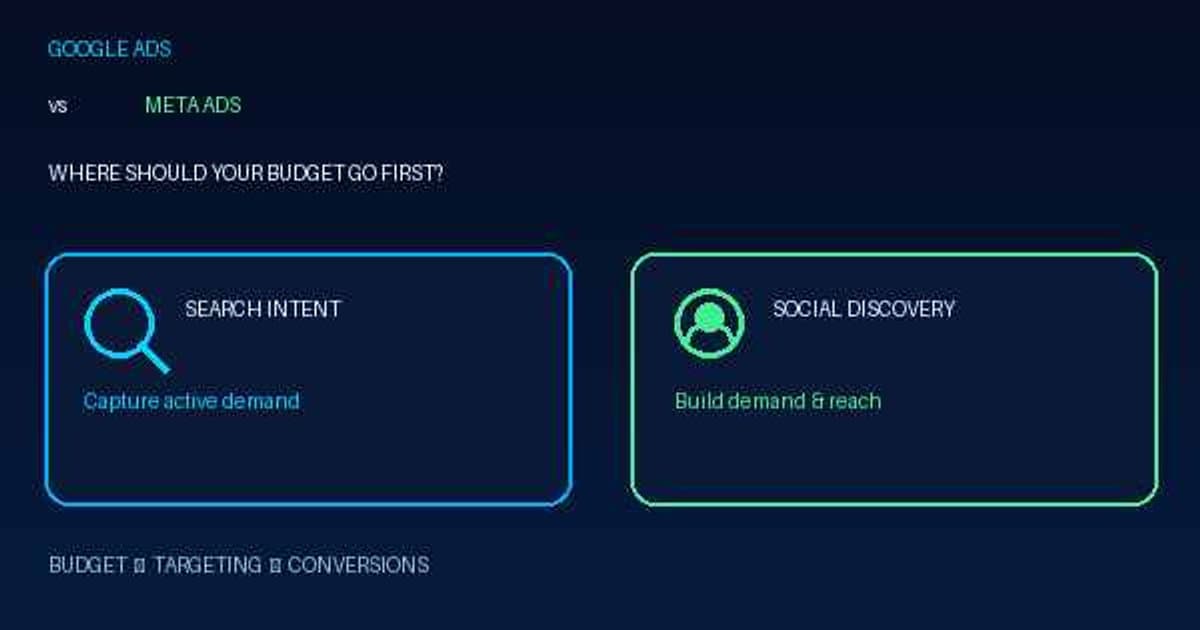
If people already search for what you sell, start with Google Ads. If your offer needs some explanation or is highly visual, start with Meta Ads. With a growing budget, running both together usually outperforms putting everything into either one alone.
Intent vs. Discovery — The Core Difference
Google Ads captures people who are actively searching for something — they already know they have a need and are looking for a solution. That intent makes search ads highly effective for products or services people actively look for, but it also means you're limited to however many people are searching.
Meta Ads work the opposite way: you're reaching people based on who they are and what they're interested in, not what they just searched for. That's powerful for building awareness or reaching an audience that doesn't know it needs you yet, but it generally requires a stronger, more visual pitch to earn attention.
Which Platform Fits Your Offer
If your product or service solves a problem people actively search for — "emergency plumber near me," "CRM software for small teams" — Google Ads usually delivers faster, more predictable results because you're meeting existing demand.
If your offer is more visual, aspirational, or requires some explanation before someone realizes they want it, Meta Ads tends to perform better, since the format is built for storytelling rather than answering a direct query.
How Budget and Timeline Should Shape the Decision
With a limited first budget, it's usually better to concentrate spend on one platform long enough to gather real performance data than to split it thin across both. Search campaigns often show directional signal within the first couple of weeks; social campaigns typically need more time and testing to find an audience that converts.
As budget grows, running both in tandem tends to outperform either alone — search captures people who are ready now, while social builds the audience that will be ready later.
Source: Meta Business Help Center — About the learning phase.
Measuring What Actually Matters
Regardless of platform, the metric that matters is what happens after the click — not just cost per click or impressions. Clean tracking through GA4 and Tag Manager is what turns ad spend into decisions instead of guesses.
Without that visibility, it's easy to keep spending on a channel that looks cheap per click but never actually turns into revenue.
Quick Comparison at a Glance
Figures last checked: October 2026 — against public pricing pages and published 2026 industry rate guides.
| Platform | Who you're reaching | Typical cost per click | Best first channel if... |
|---|---|---|---|
| Google Ads | People actively searching right now | Higher (about $5 on average) | ...people already search for what you sell |
| Meta Ads | People matching an interest/audience profile | Lower (often under $1) | ...your offer needs explanation or is visual |
What the Numbers Actually Look Like
Published 2026 advertising benchmarks put the average cost per click for Meta traffic campaigns at well under $1 — commonly cited around $0.60 across industries — while Google Search ads averaged $5.42 per click across industries in LocaliQ's 2026 benchmarks, several times Meta's cost, though the figure varies widely by industry.
That gap isn't a sign that Meta is simply "cheaper and better." A Google search click usually comes from someone who typed in exactly what they're looking for, which tends to convert at a higher rate even at a higher cost per click. A Meta click often comes from someone scrolling who wasn't actively looking for a solution yet, so the cost-per-click advantage can be offset by a lower conversion rate from that same click.
This is why cost per click alone is a misleading way to compare the two platforms — cost per actual result (a lead, a sale) is what determines which channel is actually performing better for your specific offer, and that number varies a lot by industry and by how well the landing page converts the traffic it receives.
Sources: LocaliQ (WordStream) — Facebook Ads Benchmarks for Your Industry (September 2026); LocaliQ (WordStream) — Search Advertising Benchmarks for Your Industry (June 2026).
This ties directly into our Digital Marketing service, where we go deeper on scope, process, and cost.
We go deeper on automation for eCommerce businesses on our dedicated industry page.