AI Agents vs. Traditional Automation: What's the Difference?
The Nexa Solutions Team
4 min read
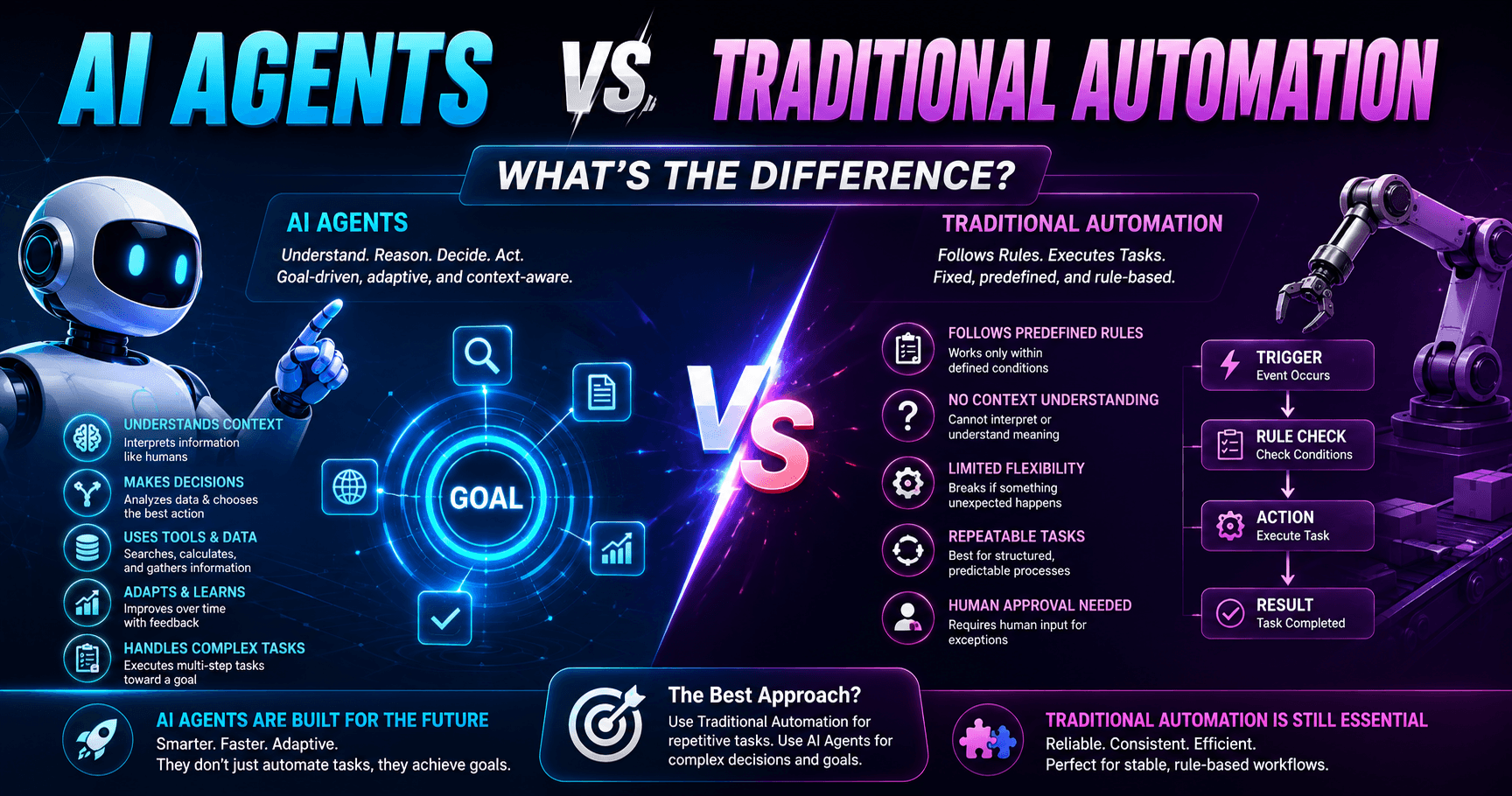
Table of Contents
AI Agents vs. Traditional Automation: What's the Difference?
Businesses have been automating repetitive tasks for years.
From sending automated emails to moving information between spreadsheets and CRM systems, traditional automation has helped companies save time and reduce manual work.
But a new type of automation is changing the conversation: AI agents.
Unlike traditional workflows that usually follow predefined rules, AI agents can interpret information, make decisions, use tools, and complete multiple steps toward a goal.
So what's the difference?
And more importantly, which approach should your business use?
What Is Traditional Automation?
Traditional automation works according to predefined instructions.
For example:
New form submission → Add customer to CRM → Send email → Notify sales team
The system follows the exact instructions it was given.
If the information matches the expected conditions, the workflow continues.
If something unexpected happens, the workflow may stop or require additional rules.
Examples of traditional automation
Businesses commonly use automation for:
Email notifications CRM updates Data synchronization Invoice generation Appointment reminders Lead routing Spreadsheet updates File processing Scheduled reports
Traditional automation is extremely useful when a process is predictable and repeatable.
What Is an AI Agent?
An AI agent is designed to work toward a goal rather than simply follow one fixed sequence of instructions.
An AI agent can potentially:
Understand natural language Analyze information Make decisions based on context Use connected tools Perform multiple steps Adapt its actions based on results Escalate situations to humans
For example, instead of simply receiving a customer email and sending a predefined response, an AI agent could analyze the customer's request, search a knowledge base, check account information, create a support ticket, and determine whether a human needs to become involved.
Traditional Automation vs. AI Agents
The simplest way to understand the difference is this:
Traditional automation
Rules → Actions
AI agent
Goal → Reasoning → Actions → Results → Next decision
Traditional automation is usually deterministic.
AI agents are more flexible because they can respond to changing information.
Example: Lead Management
Imagine a company receives a new lead.
Traditional automation
The workflow might be:
New lead → Add to CRM → Send email → Assign salesperson
Every lead goes through essentially the same process.
AI agent
An AI agent could:
Read the lead information. Analyze the company's industry. Identify potential requirements. Score the lead. Research relevant information. Categorize the opportunity. Draft a personalized email. Assign the lead to the appropriate salesperson. Create a follow-up task.
The workflow can potentially adapt depending on what the agent discovers.
When Traditional Automation Is Better
AI agents aren't always the right answer.
Traditional automation is often better when the process is:
Highly predictable Rule-based Repetitive Easy to define Low in variability Dependent on exact conditions
For example, if you simply need to send an email every time someone submits a form, there's probably no reason to introduce an AI agent.
A simple automation is faster, cheaper, and easier to maintain.
When AI Agents Make More Sense
AI agents become more useful when the process involves:
Unstructured information Natural language Multiple decisions Changing circumstances Research Complex workflows Different possible outcomes
For example, customer support, research, sales qualification, document analysis, and business intelligence can potentially benefit from agentic workflows.
The Best Approach May Be Both
Businesses don't necessarily have to choose between AI agents and traditional automation.
In many cases, the strongest architecture combines them.
For example:
Traditional automation can trigger a workflow.
↓
AI agent analyzes the situation.
↓
Traditional automation updates the CRM.
↓
AI agent determines the next action.
↓
Automation sends the notification.
This hybrid approach can provide the reliability of traditional automation with the flexibility of AI.
What Businesses Should Consider
Before implementing an AI agent, ask five questions.
- Is the process predictable?
If yes, traditional automation may be enough.
- Does the workflow require judgment?
If yes, an AI agent may be useful.
- Does the workflow deal with unstructured information?
If yes, AI can help interpret that information.
- What happens if the AI makes a mistake?
Define human approval and escalation mechanisms before deployment.
- Can you measure the result?
Define metrics such as:
Time saved Cost reduction Response time Conversion rate Customer satisfaction Error reduction
Automation should produce measurable business value.
The Future of Business Automation
The future isn't necessarily about replacing traditional automation with AI agents.
It's about combining the right technology with the right business process.
Simple tasks can remain fully automated.
Complex tasks can use AI agents.
High-risk decisions can include human approval.
This creates a layered approach where each process uses the appropriate level of intelligence.
Final Thoughts
Traditional automation is excellent at executing predictable instructions.
AI agents are more useful when businesses need systems that can interpret information, make decisions, and adapt to changing circumstances.
The key isn't choosing the technology that sounds more advanced.
It's choosing the technology that solves the problem most effectively.
Automate the predictable.
Augment the complex.
Keep humans in control where judgment matters.
Ready to Automate Your Business?
Book a free strategy session and we'll show you exactly where automation could save your team the most time.
Frequently Asked Questions
Keep Reading
Related Posts
Ready To Automate Your Business?
Book a free strategy session and we'll show you exactly where automation could save your team the most time.