On this page
The Short Answer
An AI agent handles a multi-step task by breaking the goal into a sequence of steps, then completing each one through real connected systems such as a calendar, CRM or inventory database. When something goes wrong it adjusts, offering alternatives or asking a question, and it escalates to a person with full context when a request is beyond its scope.
Breaking a Goal Into Individual Steps
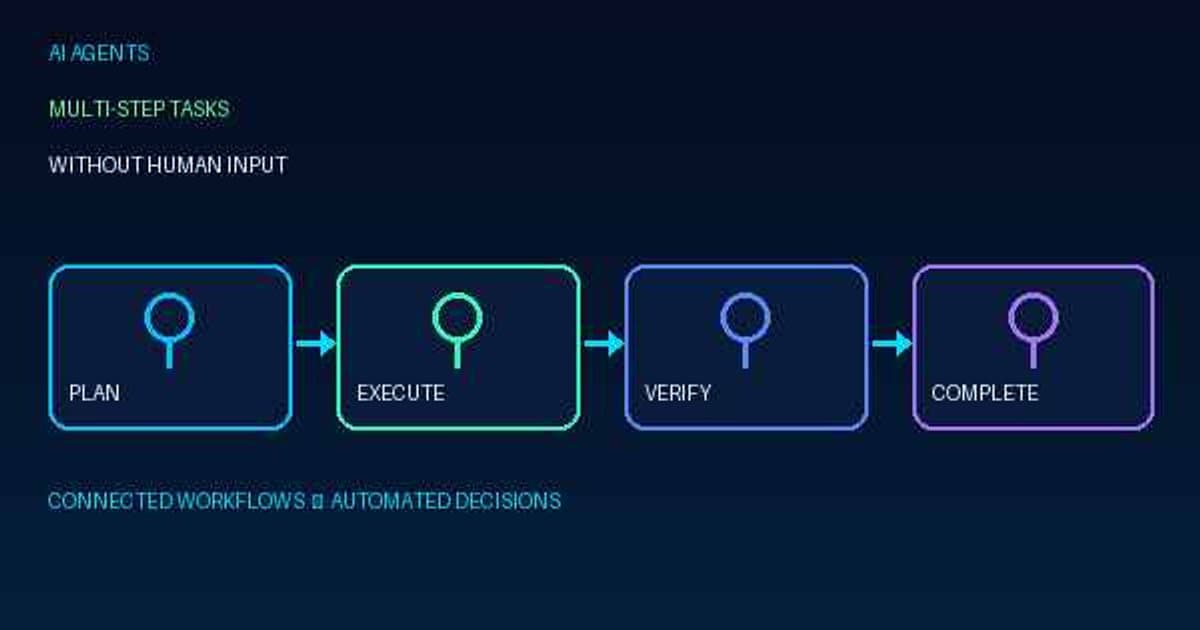
When an agent receives a request — say, "reschedule my appointment to next week" — it doesn't execute a single action. It breaks the goal into a sequence: understand the current appointment, check available slots, confirm the new time works, update the booking system, and notify the customer.
This planning step is what separates an agent from a simple automation trigger. Instead of following one fixed path, it works out which steps are needed based on the specific request in front of it.
Source: Anthropic — Building effective agents (December 2024).
Calling Tools and Systems Along the Way
Each step in that sequence usually means the agent needs to interact with a real system — a calendar API, a CRM, an inventory database. Agents are connected to these tools directly, so "check available slots" isn't a guess, it's a real query against your actual scheduling system.
This is why the integration work behind an agent matters as much as the agent's reasoning itself — an agent is only as useful as the systems it's actually allowed to read from and act on.
Source: OpenAI — Function calling and other API updates (June 2023).
What Happens When Something Doesn't Go As Planned
Real conversations are messy. A requested time slot might be unavailable, a customer might change their mind mid-conversation, or a system might return unexpected data. A well-built agent re-evaluates and adjusts — offering alternative times, asking a clarifying question, or trying a different approach — rather than simply failing.
When the situation goes beyond what it's equipped to resolve, it escalates to a human with the full context already attached, so nobody has to start the conversation over from scratch.
Source: OpenAI — A practical guide to building agents (April 2025).
Why This Matters More Than It Sounds
The practical impact is that an entire process — not just a single answer — can run without someone manually shepherding it through each step. That's the difference between a tool that saves a few seconds and one that removes an entire task from someone's day.
It also means agents can operate outside business hours, on weekends, and during traffic spikes without needing anyone on standby, since the multi-step logic runs the same way regardless of when the request comes in.
This ties directly into our AI Agents service, where we go deeper on scope, process, and cost.