On this page
The Short Answer
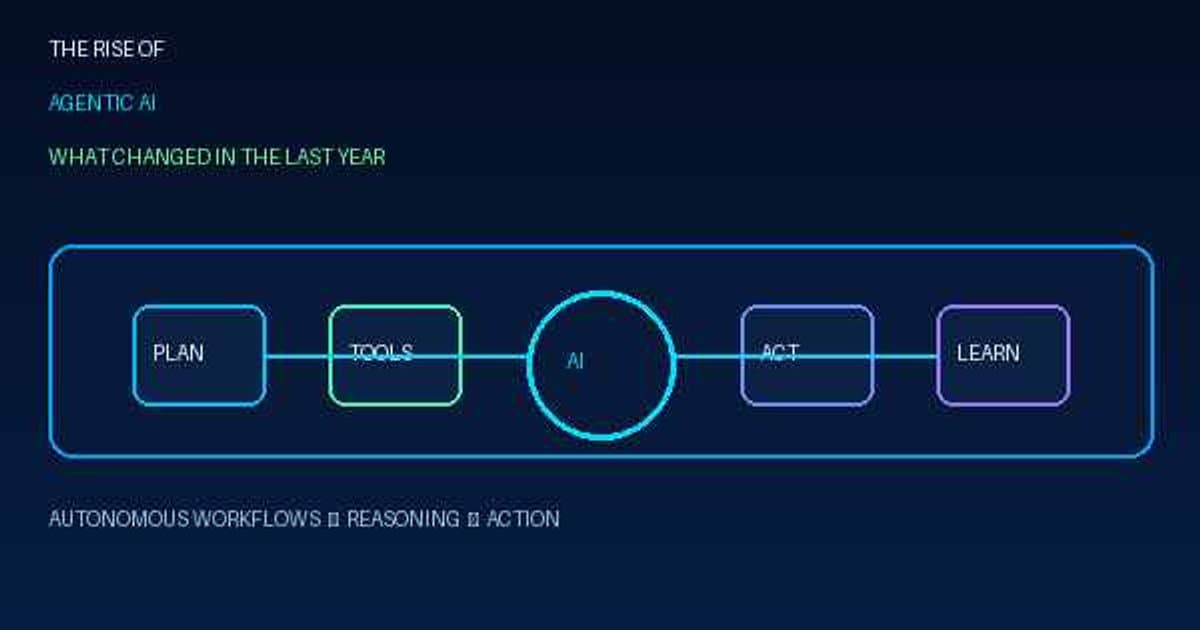
Agentic AI means models that take actions rather than only answering questions: they call APIs, update systems and complete tasks. It became practical as models grew more consistent at reasoning and integration tools matured. Today it suits bounded tasks such as lead qualification, support triage and internal requests, and the businesses seeing the best results start narrow and expand deliberately.
From Answering Questions to Taking Action
Early generative AI tools were primarily good at answering questions and generating text. The recent shift is models that can reliably use tools — calling APIs, browsing data, updating systems — as part of completing a task, not just describing what should happen next.
That shift from "describe an answer" to "take the action" is the core of what "agentic" means, and it's what makes agents useful for real operational work rather than just conversation.
Source: OpenAI — Function calling and other API updates (June 2023).
Why This Became Practical Now, Not Earlier
Reliable tool use requires models that can reason carefully about when and how to use a tool, correct course when something goes wrong, and stay within defined boundaries — improvements in reasoning consistency over the past couple of years made this practical at a business-usable reliability level.
Better integration infrastructure also mattered — it's not just the model that changed, it's the ecosystem of tools and platforms making it easier to connect models to real business systems safely.
Source: Anthropic — Introducing the Model Context Protocol (November 2024).
What This Actually Means for a Business Today
In practice, it means tasks that used to require either a rigid, brittle script or a human end-to-end can now be handled by a system that adapts within a defined scope — lead qualification, support triage, and internal request handling are common early use cases.
It doesn't mean every task should be handed to an agent immediately. The technology is capable, but the businesses seeing the best results are the ones starting narrow and expanding deliberately, not automating everything at once.
Source: Gartner — Gartner Predicts Over 40% of Agentic AI Projects Will Be Canceled by End of 2027 (June 2025).
What's Likely to Change Next
Expect continued improvement in reliability and cost, which will make agentic systems practical for a wider range of smaller, less obviously high-value tasks over time — the same way automation itself became accessible to smaller businesses as tooling matured.
The fundamentals won't change though: the businesses that benefit most will still be the ones that understand their own processes well enough to know exactly what they want an agent to do.
This is part of our AI Agents service — see how it works, what's included, and what it typically costs.